

“Hate has won, the artist has lost…,” Indian stand-up comedian Munawar Faruqui tweeted hours after his Bengaluru show was cancelled. It marked at least the 12th time Mr Faruqui’s show had been cancelled after threats to the venue and the audience. Earlier this year, the 29-year-old Muslim artist spent a month in jail for allegedly joking about Hindu deities, an accusation that the police didn’t have any evidence for. That’s what a ‘joke’ can cost you in India today.
Or rather, in one of the two Indias that stand-up comedian Vir Das described in his Emmy-winning monologue which exposed the blatant hypocrisy prevalent in the country, including in relation to the plight of religious minorities, farmers, women and Dalits. The video went viral on social media, and immediately received a flurry of reactions, with right-wing activists calling for his arrest.
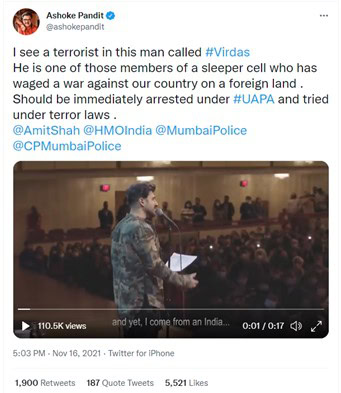
This growing intolerance towards dissent has seriously threatened the right to freedom of expression in India. Some have even become so intolerant that they can equate a man who ‘jokes’ (although, many would agree that what he said was the truth) with being a terrorist.
If an artform like ‘comedy’ or ‘satire’ can be accused of such a crime, where is the freedom of expression for poets, journalists, singers and others? Fellow comedian Kunal Kamra, who came out in support of Mr Faruqui, summarised it well: “The impulse of any artist to be calculative, a move in itself is the slow death of the art form. Laughter is beautiful, honest & most spurred by spontaneity- if a comedian is calculating what they should present to the audience for the audience to laugh at, the audience will also soon think what they should laugh on.”
There have been several other attacks on freedom of expression in recent months. For example, just last month two women journalists were arrested for reporting on attacks on mosques in the state of Tripura. They were accused of instigating communal disharmony and spreading fake news after they published a series of tweets with images of burnt mosques.
How can a democracy thrive or even exist, if its people are not allowed to express dissent? How can we ensure religious minorities are safe and treated equally if we are threatened and attacked for speaking out against the injustices meted out against them?
A constitutional right
Under Article 19 (1a) of the Indian Constitution, every citizen has the right to express one’s views and opinions on any issue through any medium, including word of mouth, writing, printing, picture, film, and others.
This was demonstrated recently by the case of Congress leader Salman Khurshid, whose book ‘Sunrise over Ayodhya’ triggered fierce reactions from people who were displeased with the fact that he compared Hindu fundamentalism to the Islamic State. There was a huge outcry and a plea seeking to ban his book, but the Delhi High Court dismissed the plea, stating that the right to dissent was the essence of a vibrant democracy.
The court also said in its order that the “fundamental right guaranteed in our constitution can neither be restricted nor denied merely on the perceived apprehension of the view being unpalatable or disagreeable to some” and that “democracy would be in peril if creative voices are stifled.”
A double standard
Like all freedoms, there are boundaries to freedom of expression. There is free speech and there is hate speech. All of the above incidents were cases of genuine criticism, criticism that exposed the suffering of minorities, criticism of the government and the majority. While on one hand, such genuine criticism is suppressed, on the other hand, hate speech by right-wing politicians in which they threaten to get rid of religious minorities is often treated with impunity.
In recent years, writers who speak the truth have been murdered, theatres have been attacked for showing films that are non-conformist, books have been banned, and even social media users have been prosecuted for sharing information that may be critical of the majority.
At the same time, actors like Kangana Ranaut, who praise the government and its right-wing ideology are being honoured with national awards, while comedians like Mr Faruqui are targeted by law enforcement who convince organisers to cancel his shows.
Freedom of expression is vital for the defence of democracy. It is also essential for the right to freedom of religion or belief to be fully realised. More must be done to protect this right in India before more voices are stifled and the only ones that we hear belong to those who are puppets in the hands of a majoritarian state.
By CSW’s India Desk
 English (UK)
  Español de México
  简体中文
简体中文