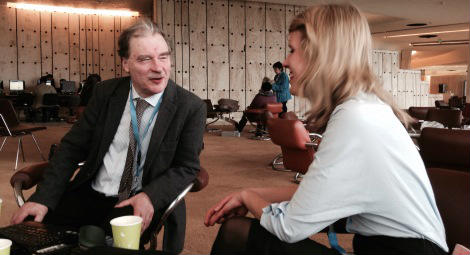

In June we went to the UN Human Rights Council in Geneva to highlight our concerns about the link between religious freedom and the refugee crisis, in particular the appalling situation of Eritrean refugees fleeing their country. We caught up with Sini Maria Heikkila, our Public Affairs Team Leader, to find out what happened.
Sounds like it was a great opportunity to speak at the Human Rights Council! How did it go?
It was a fantastic time! It’s been really encouraging over the past few years to see how CSW’s work is being taken seriously by the UN, and the chance to present our recommendations on the refugee crisis was just the latest example of that.
The tragedies of the refugee crisis have been all over the news, but it’s sometimes a bit difficult to know exactly what’s causing this mass catastrophe. Is there really a strong link between religious freedom and the refugee crisis?
Definitely. It’s one of the major reasons, actually, why people are forced to flee their homes. In our report we cover four case studies showing this. For example, there are 1 million Muslims in Burma from the Rohingya people group. A 1982 law removed their citizenship, which means they live with no rights in their own country. In May 2015 the media reported that 8,000 Rohingya and Bangladeshi refugees were stranded on boats off Thailand, with no food or water. Neighbouring countries refused to take them in. Eventually Burma rescued some of them, but emphasised that no Rohingyas would be allowed to stay. On p.5 you can read more about their situation.
We’ve heard the media using the words ‘refugee’ and ‘migrant’ interchangeably – but what’s the difference?
According to the 1951 Refugee Convention, a refugee is someone who ‘owing to a well-founded fear of being persecuted for reasons of race, religion, nationality, membership of a particular social group or political opinion, is outside the country of his nationality, and is unable to, or owing to such fear, is unwilling to avail himself of the protection of that country’. Unlike economic migrants, refugees are forced to leave their countries in order to protect their lives as their own governments either fail to protect them, or in many cases, actively repress them and threaten their lives.
I see. So what exactly does the Human Rights Council do to help victims of persecution?
It’s the HRC’s job to strengthe¬n human rights around the world, and to make recommendations for action on situations where human rights are being violated. Organisations like CSW have various opportunities to contribute at the HRC by submitting research, organising side events and meeting official representatives of various countries. These are extremely important ways for us to feed into the UN’s decision-making process – and advance religious freedom around the world!
So what are the next steps?
We met a number of country delegations and are committed to keeping freedom of religion or belief on the HRC’s agenda. Of course, it’s a long term process so we don’t expect to see the world change overnight, but one thing is for sure: we won’t stop campaigning! Right now I’m updating the report we took to the HRC in June, and my team are working on an event for UK MPs and peers, focusing specifically on the Eritrean refugee crisis and the UK government’s response. Please pray for us as we look at other ways to urge decision-makers to tackle the root causes of this crisis.
>>You can download the full report at www.csw.org.uk/report-persecution-refugees
 English (UK)
  Español de México
  简体中文
简体中文