You’ve been praying for our UN work for years, and in April 2017 we saw one of the biggest answers to those prayers when CSW was granted Special Consultative Status – a form of UN accreditation – after many years. As you may know, the UN is key to much of CSW’s work. We sat down with Claire, our United Nations Officer, to find out more.
Can you tell me a bit about your job and what you do at the UN?
I represent CSW at the UN in Geneva and in New York. I take CSW’s research and analysis and try to influence UN policy makers, world leaders and state representatives to take freedom of religion or belief seriously, and to act on our recommendations.
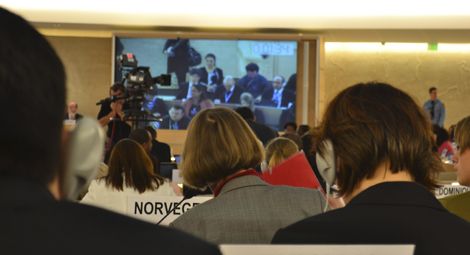
When I am at the UN, I arrange private meetings with different country representatives and give evidence at the Human Rights Council. I also provide written reports on the countries we work on, as well as on individual cases of concern, which allows the UN to investigate further; and I support the work of UN experts who promote and protect freedom of religion or belief. Because we hold UN accreditation, CSW is able to host seminars and panel discussions which country representatives and other NGOs are invited to attend. There’s always a lot going on!
Why does CSW work with the UN?
The United Nations is an international organisation currently made up of 193 Member States, and it is huge – tackling issues ranging from peace and security to climate change and food production. As such, the credible evidence and research provided by NGOs who have expertise in these different situations is vital. What’s more, we can push for accountability where a state fails to protect and promote the rights of its citizens.
CSW is privileged to hold Special Consultative Status, which enables us to speak directly to the UN on issues relating to freedom of religion or belief.
The main forum we engage with is the UN Human Rights Council (HRC) in Geneva. Consultative status enables us to engage in this arena, which is fantastic as there’s nothing else quite like it internationally. One criticism we sometimes hear of the UN is that it’s not effective – it’s just bureaucrats who make decisions that don’t make any difference to real people. How would you answer that? While the system is not perfect, the UN’s mechanisms remain the foremost way of raising human rights issues around the world. I’ve had the privilege of taking human rights defenders and also victim-survivors of human rights abuses to the UN to share their stories and tell the international community what the real situation is for them in their country, the challenges they face on a daily basis and what the international community should do to ensure the situation improves. The difference this opportunity makes to the individuals and their communities is untold.
In March 2018, Yona G. Nati travelled with CSW to the HRC to tell the story of how his father was forcibly disappeared in Eritrea when Yona was just a teenager. He said, ‘Without the support of CSW I, or others like me, would never get the opportunity to voice the injustice that is committed by the head of states in our parts of the world.’
That said, CSW is concerned that many states who have repeatedly failed to show any commitment to the protection and promotion of human rights, including those of their own citizens, or any regard for international standards, have been recently elected to sit on the HRC. We will continue to challenge this, and are calling for the UN to take this issue seriously and to ensure that membership of the Council does not become a means of protecting a state from scrutiny of its human rights record. We are also calling for states who do not fulfil their human rights responsibilities to lose their seat.
When were you last at the UN? What’s the latest?
In October I was at the UN in Geneva ahead of the next round of Universal Periodic Reviews (UPRs) with a CSW partner from Mexico. We held meetings to share our concerns and recommendations on the right to freedom of religion or belief, before Mexico’s UPR.
The UPR process is one of my favourite UN mechanisms: it is the means by which each Member State has its human rights record examined every four years. NGOs can submit evidence which is collated into a report. The report is then debated for three hours, during which the state under review has to give an account for their actions. A final report, with recommendations of things that the state needs to improve upon, is published at the end of the process. NGOs like CSW can then use this report to hold the state to account for the things it has promised to improve.
 English (UK)
  Español de México
  简体中文
简体中文