
Introduction
Indonesia, the world’s largest Muslim-majority nation, is founded on a tradition of pluralism and freedom of religion, enshrined in the state philosophy known as ‘Pancasila’. Indonesia has made a remarkable transition to democracy from authoritarian rule, and is celebrated as a successful Muslim-majority democracy. Both these achievements are, however, increasingly under threat.
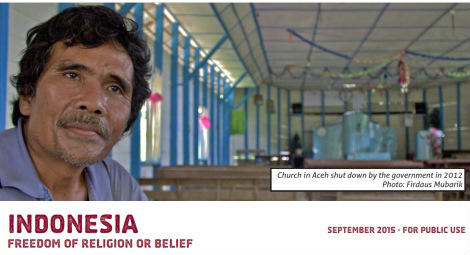
Over the past decade, violence and discrimination against religious minorities have increased significantly, year on year, and there are increasing causes for concern. Violations of freedom of religion are occurring throughout the country, affecting all communities. Christian churches have been forced to close, or have been destroyed; Ahmadi and Shi’a Muslims have been attacked; Sufi Muslims, Baha’is, Buddhists, Confucians, adherents of indigenous traditional religions and atheists have faced discrimination and, in some cases, imprisonment. The use of Indonesia’s blasphemy laws, shari’a-inspired regulations, the 2006 Joint Ministerial Decree on construction of houses of worship and the 2008 anti-Ahmadiyya decree, as well as discrimination resulting from the religion column on identity cards, have all contributed to the deteriorating situation. Ahmad Suaedy of the Abdurrahman Wahid Centre for Inter-faith Dialogue claims, “We are seeing the mainstreaming of intolerance.” CSW has documented these in many reports, notably in an in depth study published in 2014, Indonesia: Pluralism in Peril – The rise of religious intolerance across the archipelago, available on request.
Increasing violations of freedom of religion or belief throughout Indonesia have drawn attention from the international community. On 26 April 2011 the UN High Commissioner for Human Rights, Navanethem Pillay, wrote to the Indonesian Minister of Foreign Affairs to express her concerns about violations of religious freedom. While praising Indonesian human rights and civil society organisations as “among the most proactive in the region”, she said that recent incidents of violence and repression against religious minorities “put at risk the human rights guaranteed in Indonesia’s constitution, including the prohibition of discrimination and the right to freedom of religion and expression”. She called for a review of all laws, particularly those restricting religious expression and practice, to ensure they comply with standards set out in the constitution and in the International Covenant on Civil and Political Rights (ICCPR). She urged Indonesia to accept a request from the UN Special Rapporteur on freedom of religion or belief to visit the country. She repeated many of these concerns at a press conference at the end of her visit to Indonesia in November 2012. In July 2011 the European Parliament adopted a resolution which expresses “grave concern at the incidents of violence against religious minorities” and the abuses under “blasphemy, heresy and religious defamation by-laws”. Members of the US Congress have also written to the Indonesian government, and resolutions have been passed in the British and Swedish Parliaments.
In 2012 the UN conducted its second Universal Periodic Review (UPR) of Indonesia’s human rights record, and highlighted violations of freedom of religion or belief. In 2013 the Human Rights Committee of the UN reviewed Indonesia’s compliance with the ICCPR and expressed particular concerns about Indonesia’s blasphemy law, questioning its compatibility with Articles 18, 19 and 20 of the ICCPR, which cover freedom of religion, freedom of expression and hate speech. The committee recommended the repeal of Law No. 1 of 1965 on Defamation of Religion.
In 2014 a new president of Indonesia, Joko Widodo, was elected. President Widodo has a strong track record for standing up for religious pluralism, as Governor of Jakarta and Mayor of Solo, so there is now hope that the new government of Indonesia will find ways to address rising religious intolerance. CSW urges the international community to raise these concerns with the new government at every opportunity, and to encourage the government of Indonesia to take concrete steps, detailed in our recommendations set out in the report Indonesia: Pluralism in Peril – The rise of religious intolerance across the archipelago and summarised below.

 English (UK)
  Español de México
  简体中文
简体中文