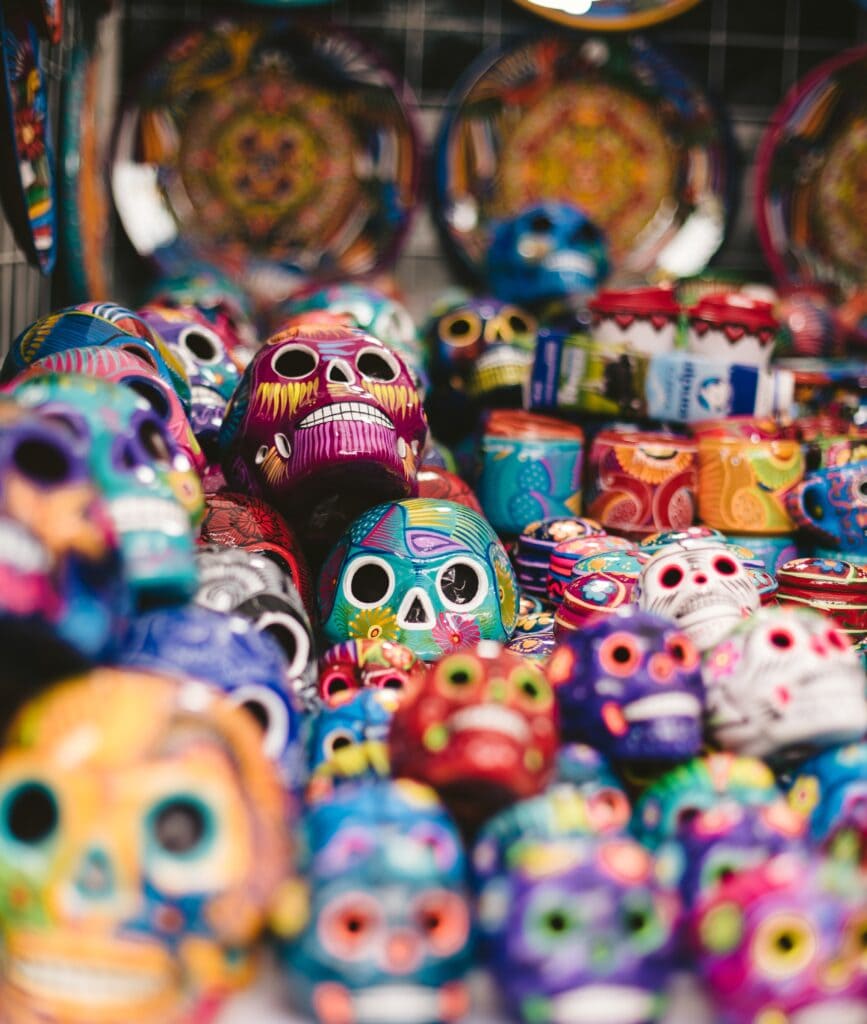
Growing up in a family, in a culture even, where death is taboo, where people are afraid to talk about it, it seemed strange to me that on the other side of the world, death is deeply ingrained in Mexican culture and in the Mexican people.
In Mexican literature and art there is a fixation with death. The celebrated Mexican poet and diplomat, Octavio Paz, wrote “To the inhabitant of New York, Paris or London, death is a word that is never uttered because it burns the lips. The Mexican, on the other hand, frequents it, mocks it, caresses it, sleeps with it, celebrates it; it is one of his favourite toys and his most enduring love […] he looks at it face to face with impatience, disdain or irony.”
A bridge between two worlds
In Mexico, this reverence of death culminates in the celebration day of Xantolo (Day of the Dead), which falls on 2 November every year. It is believed to have roots in the veneration of the Aztec goddess Mictecacihuatl “Lady of the Dead” and is a cultural blend of pre-Columbian rituals and the Catholic tradition of All Souls’ Day. It is celebrated as a bridge between the worlds of the living and the dead. However, for many religious minority groups, the Day of the Dead is one of the most difficult and dreaded days of the year, particularly for religious minority children.
For many religious minority groups, the Day of the Dead is one of the most difficult and dreaded days of the year, particularly for religious minority children.
Schools across the country celebrate the Day of the Dead as a cultural event, often encouraging children to build shrines to deceased family members and to make offerings in the form of flowers, paper decorations and other objects.
At this time of year in various communities in the states of Oaxaca, Chiapas and Hidalgo, there are frequently serious tensions between Catholics and Protestants which often lead to severe violations of freedom of religion or belief (FoRB). Children in all three states have experienced problems to varying degrees.
One example is that of Griselda, a 12 year old from Tamalcuatitla village, in the Huejutla de Reyes municipality, Hidalgo State. On the celebration day for Xantolo, teachers require that Griselda and her classmates bring chocolate and flowers as an offering to their dead ancestors.
These celebrations are part of their curriculum; in Spanish lessons students write poems to the dead and in art they perform a dance celebrating Xantolo together. The class practises the dance in the days leading up to the celebrations. Griselda’s classmates and teacher try to persuade her to participate, however, Griselda’s beliefs mean that she does not wish to take part.
A legal right to object
Article 5 of the UN Declaration on the Elimination of All Forms of Intolerance and of Discrimination Based on Religion or Belief states that “Every child […] shall not be compelled to receive teaching on religion or belief against the wishes of his parents or legal guardians”. This gives students like Griselda a legal right to object to their participation in religious activities that contradict their beliefs, however this right is rarely respected in situations such as these.
Since this right is not respected and the teachers refuse to make any accommodation for Griselda, her sister and three other protestant children at the school, they feel they have no other choice but to refuse to attend school on that day. On the Day of the Dead, in 2017, the students’ teacher threatened to mark them down in Spanish and art classes if they did not participate. In this case the threat was not followed through.
The situation has been the same for many years. Members of religious minorities, including Protestants, and Muslims, but also some Roman Catholics object to their children being forced to participate in what they consider a religious activity which contradicts their beliefs. On numerous occasions children have been forced to participate in religious activities against their wishes those of their parents.
Religious homogeneity – a path to peace?
Mexico’s recent National Discrimination Survey 2017 (Encuesta Nacional sobre Discriminación 2017) focused on 10 different root causes of discrimination in Mexico. One of the findings was that 45% of those surveyed believe that the more religions allowed in the country, the more social conflict will arise.
This may help to explain why religious majorities often try to enforce religious conformity and coerce religious minority groups into cooperating, and why moderate to severe FoRB violations are ongoing in the country.
Some believe that the peaceful society is one in which everyone accepts the same belief system. However, there can be harmony even in diversity.
On this Day of the Dead, religious majority groups that seek to impose conformity and force participation would do well to recognise and celebrate a different bridge between two worlds.
The right to freedom of religion or belief can be a bridge that makes the peaceful co-existence between religious groups possible, and one of the hallmarks of a peaceful society is one in which the right to freedom of religion or belief is promoted, protected and upheld for people of all faiths and none.
By CSW’s Latin America Advocacy Officer


 English (UK)
  Español de México
  简体中文
简体中文