

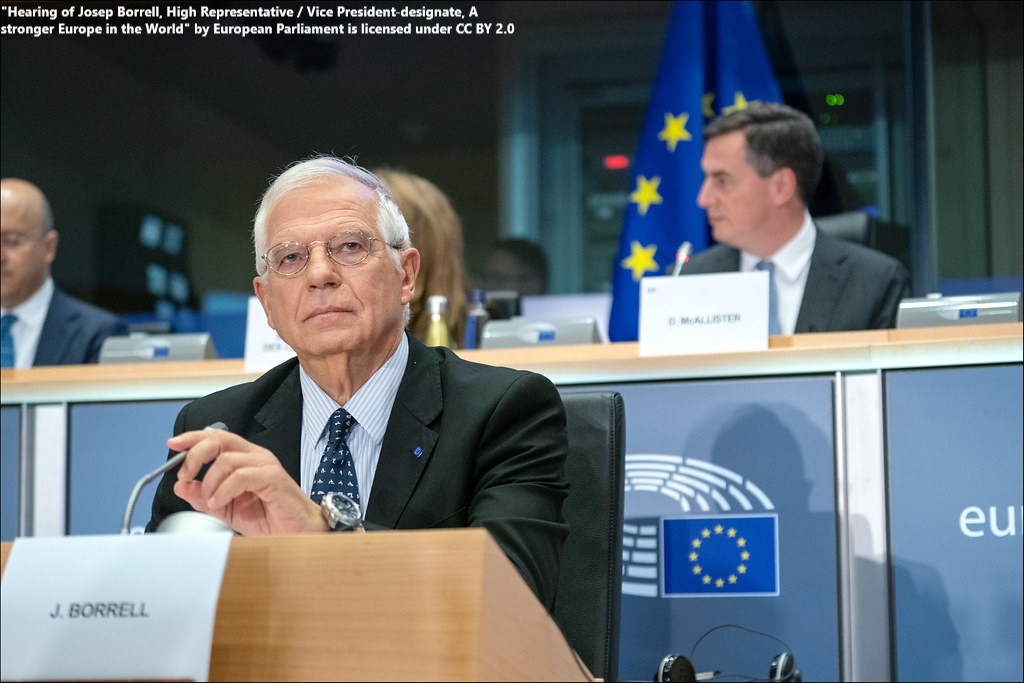
On 7 December, the EU officially approved the creation of its newest human rights mechanism, the European Union (EU) Global Human Rights Sanctions Regime.
It will enable the European bloc to impose EU-wide travel bans on, freeze the assets of and prohibit the availability of funds and economic resources to individuals and entities who have committed or been associated with serious human rights abuses. It will target both state and non-state actors, regardless of where they are in the world and where they committed their crimes.
The mechanism is informally known as the EU-styled Magnitsky Act, after the US model that preceded it. The US Magnitsky Act was signed by President Barack Obama in 2012 and was originally designed to target Russian officials who were responsible for the death of the Russian tax lawyer Sergei Magnitsky.
The fact that the mechanism enables the targeting of specific individuals responsible for violations of human rights could have significant implications for individuals in many of the countries in which CSW works. For example, the US Magnitsky Act has been used toimpose sanctions on those responsible for violations in China’s Uyghur Region. In the first designation under its own sanctions regime, the UKtargeted, among others, two high-ranking military generals from Myanmar (Burma) involved in the systematic and brutal violence against the Rohingya people and other ethnic minorities, and two organisations involved in the forced labour, torture and murder that takes place in North Korea’s gulags.
The road to a sanctions mechanism
The EU Global Human Rights Sanctions Regime follows similar ones already in place in the US, Canada and the UK, and comes as a result of several EU Member States pushing for it at a national level last year. The most notable of these was the Dutch government, whose parliament’s resolution of November 2019 called for an EU sanctions regime to be established.
Following this move, discussions among several foreign affairs ministers of the 27 EU Member States led to a declaration by the EU High Representative for Foreign Affairs and Security Policy, Josep Borrell, in December 2019: “On the request of several member states, we have agreed to launch the preparatory work for a Global Sanctions Regime to address serious human rights violations which will be the European Union equivalent of the so called ‘Magnitsky Act’ of the United States.”
Mr Borrell, who was originally unaware of the US Magnitsky Act, was quick to get behind the idea of a European equivalent. In addition, the relatively rapid consensus among the Member States regarding the creation of the EU Global Human Rights Sanctions Regime was encouraging for a bloc that has struggled with repeated internal disagreements and vetoes, for example regarding the coronavirus economic recovery fund. It is also hoped that the EU Global Human Rights Sanctions Regime will provide for information sharing and stronger cooperation on human rights with countries such as the UK, Canada and the US.
A wide-ranging and landmark initiative
In a statement, Mr Borrell said: “The establishment of the EU Global Human Rights Sanctions Regime is a landmark initiative to underscore the EU’s determination to enhance its role in addressing serious human rights violations and abuses worldwide.”
He added: “The EU Global Human Rights Sanctions Regime is not country-specific. It can tackle serious human rights violations and abuses worldwide, including those taking place cross-border. It complements geographical sanctions regimes addressing human rights violations and abuses.”
“Sanctions alone cannot prevent or end all human rights violations and abuses. They are intended to change an actor’s behaviour and serve as a deterrent to serious human rights violations and abuses.”
Practical Application
The statement also stressed that the application of the sanctions regime would be “consistent with the EU comprehensive foreign policy approach.”
In theory, the mechanism shares its fundamental aspects with those of other countries and gives the EU High Representative Josep Borrell and the European Council the right to establish, review and amend the sanctions list. The mechanism is mandated for the next three years at which point it will be re-assessed by the EU institutional bodies. In the meantime, the sanctions list will include a yearly review process.
Much like other regimes however, the EU version is lacking one critical component, namely, a mechanism by which civil society can engage in both the consultation and review of sanctions imposed.
At the launch event of the new EU Action Plan on Human Rights on 7 December, in response to a question from CSW, the EU Special Representative for Human Rights, Mr Eamon Gilmore, said that civil society engagement is “very strongly underlined” in the Action Plan. With regards to the EU Global Human Rights Sanctions Regime, he added that he is “very open to a discussion and consultation with civil society” but that ultimately the implementation of a civil society appeals mechanism rests with the Member States.
If the EU and its Member States are intent on upholding their human rights commitments, as demonstrated by the EU’s 60 human rights consultations with civil society ahead of its dialogues with third countries, as well as the strong consultatory status that civil society has in the new EU Action Plan on Human Rights, then the recently adopted EU Global Human Rights Sanctions Regime must reflect these wider efforts and include a civil society appeals mechanism.
By CSW’s European Liaison Officer Alessandro Pecorari
Imagen destacada: “Hearing of Josep Borrell, High Representative / Vice President-designate, A stronger Europe in the World” por Parlamento Europeo cuenta con la licencia de CC BY 2.0

 English (UK)
  Español de México
  简体中文
简体中文