

Prime Minister Theresa May’s first official visit to China, which begins today, is billed as an opportunity to boost trade with an important ally. But it will also take place against the backdrop of the country’s violations of fundamental human rights, including freedom of religion or belief.
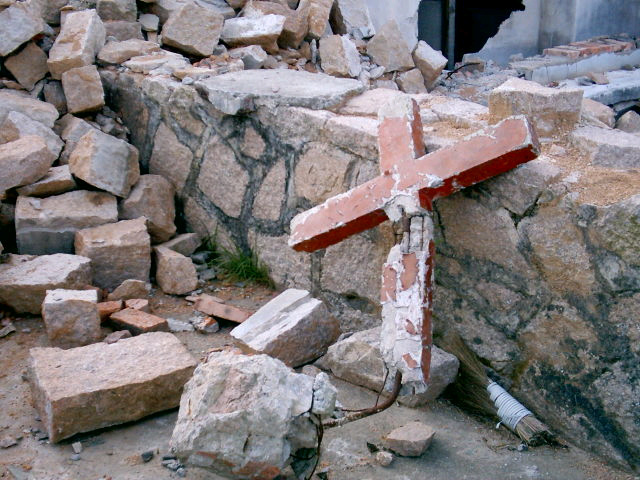
In the last month, Christians have been detained, and unregistered churches shut down or destroyed ahead of the implementation of revised Regulations on Religious Affairs, which strengthen state control over religious activities in China.
Unregistered churches, sometimes called house churches, are independent churches which have not registered with the state-sanctioned Three Self Patriotic Movement. The new regulations are due to come into force tomorrow, giving Mrs May a rare opportunity to speak directly to the Chinese government and publicly to reiterate the UK’s commitment to defending human rights.
A few weeks ago, authorities in Shanxi Province used dynamite to demolish the 50,000-member Golden Lampstand Church. Meanwhile, two pastors of Living Stone Church, an unregistered Protestant church which at one time had over 700 members, have been fined over US$1 million for collecting ‘illegal’ donations from members of the congregation.
Pastor Su Tianfu and Pastor Yang Hua have filed several appeals on the basis that the money was voluntarily donated by church members and was only used to fund church activities. The appeals were rejected.
In Yunnan province, meanwhile, hundreds of Christians have been arrested and accused of being members of an ‘evil cult’. In one such case, six members of an unregistered church group were sentenced on January 18 to up to 13 years in prison for ‘using an evil cult to undermine law enforcement’. They were accused of belonging to a group called the Three Grades of Servants, which the government has labelled an ‘evil cult’ – charges which they deny.
Although the situation for unregistered churches varies considerably from place to place, these are not isolated incidents.
China is a large country, and while different approaches are being taken by various provincial authorities, when taken together, these cases may suggest a long-term plan to target independent religious communities.
This article was originally published on 31 January by Christian Today. Click here to read more.
By Kiri Kankhwende, CSW’s Public Affairs Team Leader
 English (UK)
  Español de México
  简体中文
简体中文