
Executive Summary
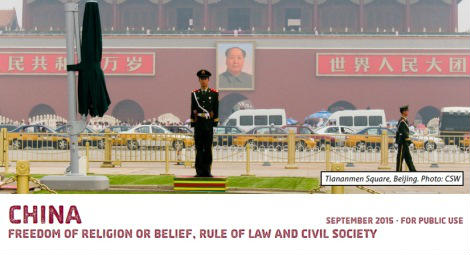
In February 2015 CSW reported that under Xi Jinping, space for civil society was shrinking. For many observers, events over the past six months have not only confirmed this view, but have also demonstrated the force with which the government is willing to strike down all perceived opposition.
The state’s concentrated efforts to prevent any activity or expression not in line with governmental objectives have recently expanded. These efforts now include the arrest or harassment of academics, online commentators and entrepreneurs, as well as lawyers, activists, journalists and members of religious communities. A wave of mass arrests and disappearances of over 280 lawyers, activists, associates and family members began on 10 July 2015, and has widely been seen as the largest concerted attack on the legal rights community for decades. Rights lawyers have suffered years of harassment, imprisonment and even torture for their work on ‘sensitive’ cases; yet the spate of interrogations, detentions and disappearances, covering 24 provinces and municipalities, has been deeply shocking because of its scope and speed. Alongside these actions against individual civil society actors, the government has introduced new and draft legislation on foreign non-governmental organisations and national security, among others. This legislation has been met with heavy criticism both from domestic human rights defenders and the international community, for its potential to further limit fundamental rights and freedoms.
It is important to understand this context when looking at restrictions on the right to freedom of religion or belief, and general conditions for religion or belief communities in China. This briefing gives considerable coverage to events in Zhejiang: the province has not only been the site of a large-scale campaign to remove crosses from churches, but has also been the target of various warnings and notices from the authorities, implementing and re-emphasising pre-existing restrictions on religious education and Party membership. The briefing also looks at the increase in the use of so-called cult legislation, and the situation for religious communities in Xinjiang and Tibet, and ends with recommendations to the Chinese government and to the international community.
Download the full report 1.2 MB

 English (UK)
  Español de México
  简体中文
简体中文