
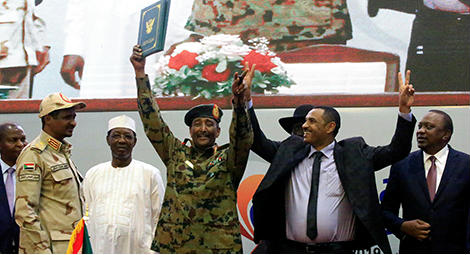

From December 2018 Sudan saw mass protests, with people across the country from all walks of life, Christians and Muslims alike, calling for freedom, justice and peace. In April President Omar al Bashir was arrested – one of the protestors’ key demands – and a transitional military council (TMC) took power. In August, the protestors and the military signed a power-sharing agreement for a three-year transition period to civilian rule. A new civilian-led government has been appointed to implement comprehensive reforms. The nation appears to be at a turning point.
What started as protests against a government decision that tripled the price of bread, very quickly developed into nationwide calls for democratic reforms and the removal of the president. Throughout the protests Christians and Muslims showed inspiring displays of religious harmony.
On 14 April, days after the president was deposed, Christians were invited to lead a service at a sit-in around the armed forces and security services headquarters in Khartoum, where they called for democracy, human rights and equal citizenship. ‘We must make a covenant that we will not withdraw or accept anything less than a new Sudan ruled by humanity and citizenship,’ said Pastor Rafaat Sameer Masaad, head of the Evangelical Synods.
As we go to print the mood in the country is one of cautious optimism – while civilians being in government is a positive step, there is a very long way to go. The military and paramilitary organisations still wield significant influence; true reform will involve limiting their powers. There will also need to be justice and accountability for human rights violations committed over the last 30 years, including during the recent protests.
Violence and an internet shutdown
From the start, the protestors suffered violence from the authorities, with hundreds losing their lives. On 3 June a sit-in in Khartoum was violently dispersed, with at least 128 people killed and over 70 verified reports of sexual assault. There were also attacks on civilians in other parts of the country and particularly in Darfur.
For months the Rapid Support Forces (RSF or janjaweed, a paramilitary group accused of serious abuses in Darfur) were out in full force across the country. It was reported that they treated civilians in a degrading manner and at times even tortured them. On 3 June the RSF forced protestors to drink polluted water. Some protestors were observing Ramadan at the time, when their religion forbids them from eating or drinking during daylight hours.
In the days after the 3 June attack, the military shut down the internet to prevent news from spreading. When the internet was restored in July, social media was flooded with footage of brutal assaults.
The international community’s response On 6 June the African Union (AU) suspended Sudan from all AU activities, acknowledging the gravity of the situation.
At the UN Human Rights Council (HRC) session in July, CSW described the Council’s inaction to date as ‘unacceptable’, and demanded that it establish an independent international fact-finding mission into the human rights violations which took place during the protests. We reiterated the need for the HRC to take meaningful action on Sudan, during the September Council session.
What’s next?
Reviving Sudan’s struggling economy will be the first priority for the new government. Following the appointment of the civilian-led administration, the US said it would consider removing Sudan from its list of state sponsors of terrorism – which would allow the international community to provide economic support to the government. Former president al-Bashir is on trial for corruption, and the new administration will need to assess whether he should face trial for other crimes committed during his 30-year rule. The International Criminal Court (ICC) still holds an arrest warrant for him for war crimes and crimes against humanity in Darfur. Meanwhile, a case against leaders from the Sudan Church of Christ (SCOC) is continuing. We reported last year that the case had been dismissed – eight leaders had been charged with trespass, among other things, for entering their church headquarters which the government had appropriated. The case was reopened in August, underscoring the need for urgent legal reform.
A revolution against injustice
‘Over 2,000 years ago, Christ led a revolution against injustice, slavery, division and hatred…This is a time to move away from the trenches of religious and ethnic discrimination and head towards an inclusive and unifying Sudanese national identity for all of us.’ These inspiring words were part of Pastor Rafaat Sameer’s April address to protestors.
It’s only because of your ongoing support that we’re able to amplify grassroots voices from Sudan such as Pastor Rafaat Sameer, and raise their plight with those in positions of influence. Thank you.
Get the latest updates on Sudan at csw.org.uk/sudanprotests
 English (UK)
  Español de México
  简体中文
简体中文