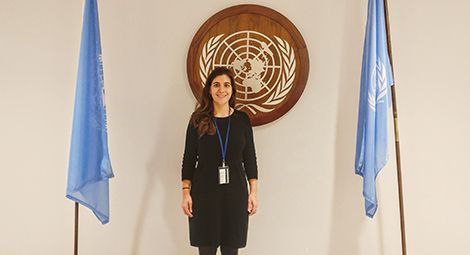

Like many of you, our staff have had to get to grips with working from home since the COVID-19 pandemic began. Claire Denman, who leads our work at the UN, has probably noticed more changes in her day-to-day role than most at CSW. We spoke to her to find out how her work has evolved, and to ask her about one of our biggest UN success stories last year: the renewal of the Special Rapporteur’s mandate on Eritrea.
So, Claire, how have you found working at the UN since the pandemic?
I must admit, engaging with the UN remotely has been quite a challenge!
The UN’s had to make some adjustments to its operational functions and procedures, because of COVID-19 and funding issues. UN staff, member states and NGOs have had to find new and creative ways of working to ensure they continue to be powerful, outspoken voices for justice in an increasingly virtual world.
What exactly has changed about the way you work?
Well, travel to start with. In a normal year I would travel back and forth between the UK and Geneva for important meetings and events, and to address the UN’s Human Rights Council. But, understandably, this isn’t possible at the moment.
So much of our work at the UN depends on building relationships with country representatives and UN staff. Prior to the COVID-19 pandemic, much of this networking would take place in person – through meetings and seminars, and often in informal settings, such as over coffee. It’s been challenging not being able to do this.
That said, I thank God every day for the blessing of technology! It really has been a lifesaver for our work. It’s meant we’ve still been able to submit case information to UN experts and I’ve been able to arrange online meetings and speak during Council sessions via video conferencing, when previously nearly all my interactions were required in person.
Many people have recognised some of the benefits of remote working since the pandemic began – have you noticed any in your work?
Yes, definitely!
In the past, we’ve brought expert witnesses to Geneva, but these opportunities have been limited, for financial or security reasons. Now, we’ve been able to invite human rights defenders from the countries we advocate for to participate in many of our online meetings, which has meant they can share their first-hand knowledge and experience directly with the UN much more easily.
In July the UN Human Rights Council voted to extend the mandate of the Special Rapporteur on the situation of human rights in Eritrea. Were you expecting this outcome?
The mandate comes up for renewal each year and it’s always a challenge to ensure we have enough countries on side to push for this. This year was certainly trickier than usual.
One of the difficulties we faced was that, at the time, relations between Ethiopia and Eritrea were thawing and the Africa Group was reluctant to take a stand against Eritrea’s human rights record.
The second major challenge was that we couldn’t travel to Geneva to lobby the various member states in person as we’d normally do. It was much more difficult to effectively apply additional advocacy pressure without being at the UN in person. So it was all the more of a victory that the mandate was renewed again this year!
And why is this mandate so important?
We’ve been lobbying for the UN Human Rights Council to take notice of the situation in Eritrea since 2009, and our first breakthrough came in 2012 when the mandate for the Special Rapporteur was introduced. The role is absolutely fundamental as it’s the only independent, international mechanism for monitoring the human rights situation in the country.
Since the situation in Eritrea remains dire – with religious groups facing severe repression and tens of thousands of people detained without charge or trial in the country’s extensive network of prisons – it’s essential that this mandate continues.
Why is it so important that CSW keeps engaging with the UN?
The UN is one of the most important arenas for raising human rights concerns internationally, including the right to freedom of religion or belief.
The UN relies on information from NGOs like CSW when reporting on, monitoring and investigating violations taking place around the world, with the aim of securing accountability for perpetrators and justice for victims.
While it’s great when the media pick up on important global issues, the UN won’t act unless it receives evidence that is verified, credible and as close to the source as possible. CSW’s consultative status at the UN means we are considered as holding specialist expertise that is valuable to the UN’s work on the right to freedom of religion or belief, so it’s crucial that CSW continues to speak up at the UN for everyone facing injustice because of their religion or belief.
There’s clearly been a lot of change at the UN this year. Do you think any of the changes are here to stay?
I hope so! The changes enabling remote participation were introduced as interim measures, but there’s been widespread support of them from NGOs and member states. In many ways the UN has become more accessible – both from a financial and security perspective – and I’m cautiously optimistic that some of these new systems will continue in a post-pandemic world. Not least as some of them should save the UN some money too!
Pray that the work of the Special Rapporteur on human rights in Eritrea would be effective, and the mandate renewed again this coming July.
 English (UK)
  Español de México
  简体中文
简体中文