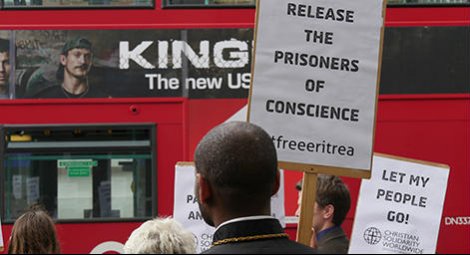

In 2016 the UN Commission of Inquiry into the human rights situation in Eritrea concluded that there were reasonable grounds to believe that crimes against humanity have been occurring since 1991, including enslavement, imprisonment, enforced disappearance, torture, persecution, rape, and murder. Tens of thousands of Eritreans remain detained without charge or trial in life threatening conditions in more than 300 sites across the country.
This month, Eritrea’s human rights record will be challenged at the 32 Session of UN’s Universal Periodic Review. CSW urges Member States to support the creation of a regional or international mechanism “to ensure accountability for continuing and past human rights violations and crimes against humanity” and to ensure the Human Rights Council formulates verifiable time-bound benchmarks to monitor Eritrea’s commitment and progress in implementing accepted recommendations.
During the second cycle of the UPR Eritrea accepted recommendations to guarantee the rights of religious minorities and protect religious communities from persecution. However, the actions of the Eritrean government tell a different story and clearly violate Article 18 of the International Covenant on Civil and Political Rights to which the state is party.
Events during the reporting period illustrate how the government’s long-held ideological antipathy towards all forms of religion has persisted with such severity that it currently stands accused of committing the atrocity crime of persecution. Interviews conducted yearly by CSW with Eritrean refugees and their community leaders in diverse localities point to the pervasive repression and systematic, egregious violations of the right to freedom of religion or belief continue.
Several hundred Christians from non-sanctioned churches are currently thought to be detained arbitrarily and indefinitely in Eritrea as a result of a campaign of arrests that has been ongoing since 2002. In a clear violation of the Convention on the Rights of the Child, in some cases children were either detained alongside their parents, detained alone despite being minors, or left unattended. For example in May 2017, 45 Christians were arrested during raids in Adi Quala. The arrests left 23 children without parental care.
CSW urges Member States to press the Eritrean government to:
Guarantee the full enjoyment of the right to freedom of religion or belief for all citizens in accordance with the constitution and international statutes to which Eritrea is party, including the African Charter on Human and Peoples Rights, and the ICCPR;
Adhere to the Guidelines on the Conditions of Arrest, Police Custody and Pre-Trial Detention in Africa and end enforced disappearance, arbitrary arrest and indefinite detention without charge or trial; and bring all long- term detainees before recognised courts of law in the presence of international observers, or release them;
Grant immediate, unhindered access for the International Committee of the Red Cross to long-term detainees in order to assess their wellbeing and ensure conditions meet UN minimum standards;
And to facilitate the ending of the civilian militia, the demobilising of army conscripts, and the aligning of secondary and tertiary education with international norms, given the ending of hostilities with Ethiopia.
Finally, CSW urges Member States to ensure the UPR process is not undermined by states that accept recommendations only to defer implementation indefinitely. Accountability is key to ensuring the process retains its integrity.

 English (UK)
  Español de México
  简体中文
简体中文