
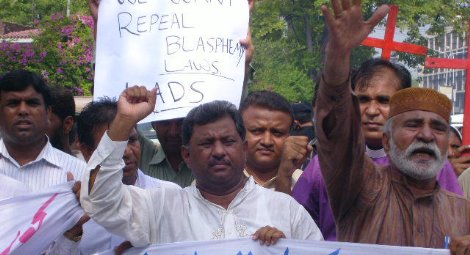
Blasphemy: Pakistan- bad laws and dangerous rumours
From the outside, it is very difficult to appreciate how serious a blasphemy accusation really is in Pakistan how devastating the results can be for the person accused, whether or not they are guilty. Think of the crimes that ignite the most anger in your own country, the ones that leave the accused marked for life. Then add the risk of being presumed guilty and lynched by a mob, long before any hint of a trial. Maybe even include the possibility of an entire neighbourhood being attacked as scapegoats and people being killed who have no connection to the original allegation.

Bad law
From the perspective of Pakistani law (articles 295A, B and C of the Pakistan Penal Code), ‘blasphemy’ is defined as generally as “insulting another’s religious sentiments”, and as specifically as “insulting the prophet Mohammed”. There is a lot of room left for personal interpretation as to what qualifies as a blasphemous act or phrase. But while the wording of the laws is open to interpretation, the punishments are not. Blasphemy is a crime in Pakistan and, at its most serious, insulting the Prophet Mohammed (Article 295C), it results in a compulsory death sentence.
The dangerous call of ‘blasphemy’
However, blasphemy under the law and blasphemy in the street are increasingly unconnected. The government could repeal the law tomorrow and would still not save its citizens from being accused and attacked. Over the past two decades the power of a blasphemy accusation to destroy lives or gather an angry mob has grown to a frightening extent. Few Pakistanis in their right mind would now intentionally insult the prophet Mohammed or damage a Qur’an, but the accusations continue to flow. Most of them are completely made up – born out of personal conflict, rivalry, discrimination or any number of other ulterior motives. Some target those who dare to question the accepted religious norm (which varies depending on the area) or who simply debate whether or not the laws are fair. It is a good example of how confused the issue has become, when those who criticise the laws are themselves accused of blasphemy – when legislation created under the previous British administration and amended by a military dictator can be declared ‘Islamic law’. And yet this distortion has had extremely serious consequences. The Governor of Punjab, Salmaan Taseer, was a critic of the laws and that is part of the reason he was assassinated in January 2011.
An issue for the nation?
In the West, accusations of blasphemy against non-Muslim minorities have received much attention in the press. This is partly because these cases often lead to wider violence against the whole community of the accused, as was the case in March 2013, for the Christians of Badami Bagh, Lahore. The assassination of Shahbaz Bhatti, Federal Minister for Minorities Affairs, in March 2011, shortly after Salman Taseer’s death, also played a part in raising the profile of the issue globally. However, statistically, it is Muslims who experience the most blasphemy cases in Pakistan. This is essential to remember not only for the sake of accurate reporting but also to make it clear that this is not a minority issue. Any Pakistani, even the most vocal supporter of the laws or a devout Muslim, faces the risk of an accusation. The smallest confrontation or misunderstanding can trigger it. Pakistan’s blasphemy laws are stifling freedoms of expression and religion, making a mockery of justice and ruining countless lives, and a major shift in mindsets is needed in Pakistan if the problem is to be tackled.
 English (UK)
  Español de México
  简体中文
简体中文