
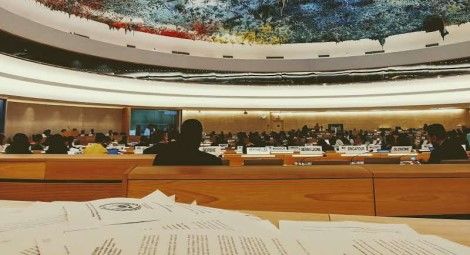

On 13 October, the United Nations General Assembly (UNGA) elected 15 new members to the Human Rights Council (HRC), to serve three-year terms from 2021-2023.
The elections, which took place via secret ballot, once again resulted in the appointment of several countries that fail to fulfil the required criteria of upholding the highest standards in the promotion and protection of human rights. However, they also have highlighted the importance of competition among states for seats on the HRC.
Countries are divided into regional groups, with states vying for seats in their group. All bar one of the regional groups had clean-slate (uncontested) elections, with the number of seats matching the number of candidates, meaning candidates needed to reach the 97-vote majority threshold in order to secure a seat, but faced no competition.
The Asia-Pacific Group (APG) was the only regional cluster that had a competitive slate, with five states vying for four seats. Saudi Arabia, whose candidacy was of concern to human rights organisations, was defeated after receiving 90 votes, the least in the group. China (139 votes), Nepal (150 votes), Pakistan (169 votes) and Uzbekistan (169 votes) were elected to the four available seats. In addition to receiving the fewest votes overall among the newly elected states, 中国 saw a drop in support from 180 votes in 2016 to 139 this year.
Other states of concern to CSW elected to the HRC include 古巴, 墨西哥, 尼泊尔, and 巴基斯坦.
The UK and France have been elected to sit on the Council as new members of the Western European and Others Group. CSW welcomes the UK’s pledge to protect and promote the right to freedom of religion or belief as a member of the HRC.
CSW’s UN Officer Claire Denman, said: “The results highlight the importance of competitive slates, as seen by Saudi Arabia’s defeat. We urge all states – especially those vying for future election to the HRC – to support competitive slates, candidate hustings and mandatory pledges. We have seen from this election how important these steps are. While CSW remains deeply concerned by the election of several states with poor human rights records, the decrease in support for China is telling, following an increasing body of evidence of ongoing gross and systematic violations underway in that country, particularly in the Uyghur region. We urge all States to ensure that membership of the HRC does not become a means of protecting a state from scrutiny of its human rights record, and that newly elected states advance, reflect and fully cooperate with the aims and purposes of the Council, both at home and abroad.”



 English (UK)
  Español de México
  简体中文
简体中文