
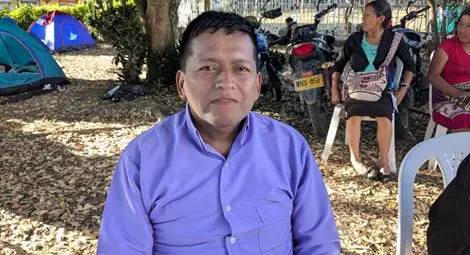
An indigenous Protestant pastor is facing forced displacement following an ultimatum issued by the traditional indigenous council on Nasa land in Cauca Department, Colombia.
On 2 October 2025 the council convened a discussion on Pastor Aristides Chocue’s presence in the community of Betania, Caldono Municipality, which concluded with an ultimatum for him to leave, with his family, before 17 October, or face punishment.
Pastor Chocue, who has worked in the community with the Nasa Evangelical Christian Church (ICEN) since February 2022, has been repeatedly warned that he must carry out his religious work ‘in accordance with the regulations established by the [traditional] council’.
‘I am not afraid,’ Pastor Chocue, who has the support of the National Board of the Nasa Evangelical Christian Church, told CSW. ‘The church tells me to continue, not to leave them. I plan to continue working, trusting in God, however, [the community] already has a history of violence against church members, and this could happen again with me and my family.’
Protestant Christians in Betania have long been subjected to discrimination and stigmatisation, threats, church closures and pressure to leave Nasa territory. In 2012 and 2021, church buildings belonging to various denominations and those inside were subject to violent assault, led by traditional leaders.
On 2 November 2021 the traditional authorities adopted a resolution ordering the suspension of dialogue with Christian churches in the territory and the closure of religious spaces, in contravention of national and international standards on freedom of religion or belief (FoRB) as guaranteed in the Colombian constitution, Colombia’s Law 133 of 1994, Article 18 of the Inter-American Human Rights Convention, and Articles 18 and 27 of the International Covenant on Civil and Political Rights.
A particular flashpoint has also emerged around the education of children and young people. Religious minority children have reportedly been put under pressure or punished in educational ceremonies for refusing to participate in traditional religious rites and ceremonies.
Over the past few months, this has escalated to the imposition of restrictions on access to health and education programmes and direct calls for their forced displacement.
‘They tell us we must accept their ideology or withdraw. But we just want to live in peace, educate our children, and follow our beliefs without fear,’a religious minority leader told CSW.
Local leaders have requested support from the Attorney General’s Office and the Prosecutor’s Office, denouncing the risk of forced displacement and the lack of guarantees for exercising their faith. However, they report that these offices have stated that the issue should be resolved by the indigenous authorities
The Protestant Christian community in Betania and surrounding areas has stated that they are willing to engage in dialogue, but request that the traditional authorities apologise to them directly, that their children can study in the community without being forced to practice traditional rituals, and that Protestant Christians are no longer stigmatised in the community.‘We want peace, but with justice and respect for [our] faith,’ said a spokesperson.
CSW’s Director of Advocacy Anna Lee Stangl said: ‘The Colombian government must take immediate action to re-establish a dialogue between the traditional authorities in Betania and religious minority leaders. This dialogue must take into account the serious FoRB violations already experienced by members of the religious minority, including children, and seek constructive ways to ensure that the fundamental rights, as established in Colombian and international law, are upheld.’
Note to Editors:
The Nasa people are also known as the Páez.


 English (UK)
  Español de México
  简体中文
简体中文