

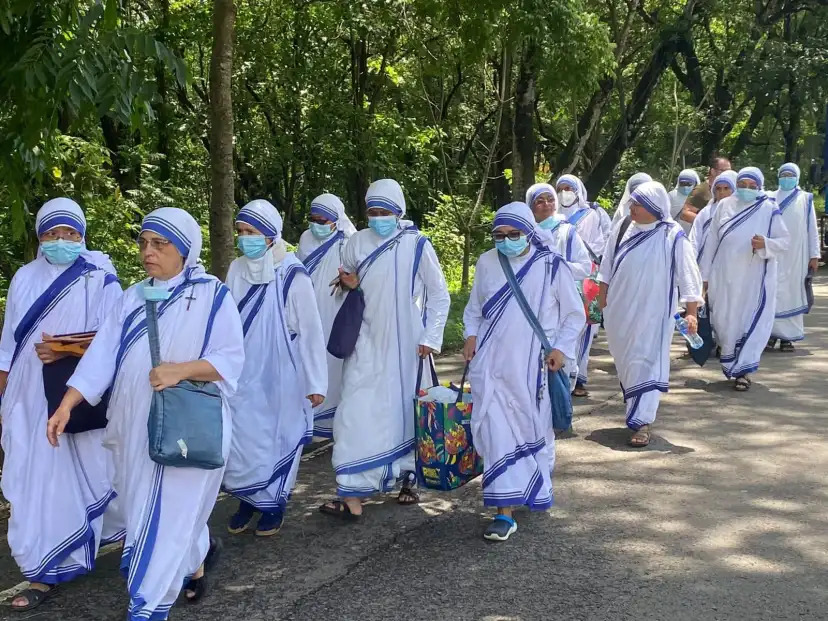
On 28 June, the Nicaraguan parliament stripped the Missionaries of Charity – the order founded by Mother Teresa – of its legal status. Days later, they were expelled from the country entirely, with local media reporting that 18 nuns were driven to the border by migration officials and police officers before crossing on foot into neighbouring Costa Rica.
No doubt the incident drew particular attention as a result of the high profile of the organisation in question, however the targeting of the Missionaries of Charity in this manner marks just the tip of the iceberg in a nationwide crackdown on civil society and non-governmental organisations (NGOs) which has been ongoing for several years.
Ever since protests erupted across the country in April 2018, and particularly since the re-election of Daniel Ortega as president in November 2021, the Nicaraguan government has acted with increasing antagonism towards anyone it perceives as critical of the current regime. This has included the Roman Catholic Church, to which the Missionaries of Charity belong, and which in February 2022 saw a number of its affiliate private universities and aid organisations targeted in a similar manner.
Protestant faith-based organisations have also been targeted, and in June it was reported that the government had cancelled a total of over 400 non-governmental organisations over the past four years.
Interestingly, these events draw concerning parallels to those taking place almost 10,000 miles away in India, where the government has pursued a similar strategy to hamper the activities of organisations that question or condemn the ruling Bharatiya Janata Party (BJP) or its policies. Even organisations which carry out activities that are considered a threat to the BJP’s nationalist agenda, risk being a target of scrutiny.
Notably, in December 2021, the BJP also went after the Missionaries of Charity, indicating that they would not renew the Missionaries’ foreign funding licence under the controversial Foreign Contribution Regulation Act (FCRA). While the licence was eventually granted on 7 January 2022, many other organisations have been less fortunate; as of 1 January 2022, an estimated 5,968 organisations had had their FCRA licence cancelled, thereby preventing them from receiving access to funding from abroad, and this number has no doubt only increased over the past seven months.
While the details of the situations in both India and Nicaragua are different, there is a common thread: government efforts to control the population.
In India, the BJP has attempted to win popular support by propagating a Hindu nationalist narrative in which to be Indian is to be a Hindu. This has in turn emboldened extremist elements to target religion and belief minorities in the country, with violations ranging from harassment and humiliation to assault, forced displacement and even extra-judicial killing.
Daniel Ortega and his government in Nicaragua, meanwhile, have sought to consolidate power by cracking down on the press, jailing government opponents, restricting online activities, and responding with disproportionate force to peaceful protests in the country.
Despite these differences, the issue at the heart of both of these cases is that of government efforts to silence dissent and maintain total control over their respective countries’ populations. Civil society, and particularly charitable organisations, many of them religious in nature, become a target when their objectives and activities, despite uplifting and empowering the communities in which they work, are perceived as competitors or threats to a government’s image, policies or nationalist objectives.
Meanwhile, the very people organisations like the Missionaries of Charity are set up to help, continue to suffer, and without a free and functioning civil society this is only likely to get worse.
The treatment of charities and wider independent civil society is an indicator of the extent to which free and open societies are allowed to flourish in a country – and the signs from Nicaragua and India are worrying. Other governments must seize opportunities to address these issues with these countries in multilateral fora, reiterating their support for organisations like the Missionaries of Charity and the many others who do not enjoy the group’s high profile, making clear their condemnation of attempts to stifle the vital work of NGOs and civil society organisations wherever they may arise in the world.
By CSW’s Public Affairs Officer Ellis Heasley
Featured image: The Missionaries of Charity deported from Nicaragua, as they arrived in Costa Rica. (Credit: Facebook/Monseñor Manuel Eugenio Salazar Mora.)

 English (UK)
  Español de México
  简体中文
简体中文