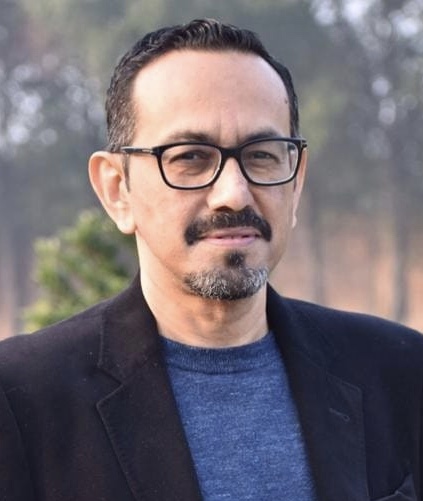
Cecil Chaudry grew up in Pakistan, watching his father champion the rights of religious minority communities. Inspired to do the same, he served as the Executive Director for the National Commission for Justice and Peace (NCJP) before joining CSW’s advocacy team.
My late father Group Captain Cecil Chaudhry was a highly decorated war hero, a fighter pilot from the Pakistan Air Force (PAF). He served 27 years in the PAF — defending the geographical boundaries of Pakistan.
After leaving the air force, my father dedicated his life to speaking up for marginalised and vulnerable religious minority communities. He served in this field for 26 years — defending the ideological boundaries of Pakistan. He became one of the country’s strongest voices for the rights of all religious minorities.
So I grew up hearing about the challenges that religious minorities face in their daily lives, and even faced discrimination myself in school and college, and later in my time as an events manager.
After the passing of my father, I became more involved in human rights work, starting by volunteering for the organisation my sister Michelle set up in my parents’ name: The Cecil & Iris Chaudhry Foundation (CICF).
Why do you advocate for freedom of religion or belief for all?
Growing up in Pakistan, I met and made friends with many who belong to the majority Muslim faith. My parents taught me to remember that we are all human beings and we must strive to live together in harmony and peace. They instilled in me the spirit of humanity, right from my childhood. I follow my father’s example, who often said: ‘By faith I am a Christian, but my religion is humanity.’
I’ve learnt that you cannot succeed in isolation, speaking up for only your own community. It is not only Christians who face challenges, but Hindus, Sikhs, Parsis, Ahmadis, Shias, Bahais and others too. Speaking up for all is the only way we can effectively advocate on the issues we hold close to our hearts.
What one key thing would you like people to know?
There are some very serious issues, but underpinning them is a mindset that has evolved over the past decades; a mindset that promotes intolerance and lack of respect for the nation’s diversity.
It stems from an education system in which biased and hateful content is prevalent in textbooks. If we truly want to address the challenges faced by different faith communities, we must address this mindset across society.
Lasting change will only come when people learn to respect others, regardless of their religion or belief. For that, education is key.
What gives you hope?
I’m very glad to say that we have started to see changes in Pakistan.
The government is developing curricula for religious minority students to study their own faith, rather than taking Ethics as the alternative to compulsory Islamic Studies.
The lower courts are being given greater protection to help them dispense timely justice, especially in false blasphemy cases. In June and July, they acquitted four such victims.
And in three of Pakistan’s four provinces, the legal age of marriage was raised to 18 and child marriage was criminalised. These changes could help reduce the abductions, forced conversions and forced marriages of Hindu and Christian girls.
Major changes take time, but even small steps forward give hope that our voices are being heard and our advocacy is working.
How can supporters make a difference?
Firstly, I truly believe in the power of prayer. We will always value your prayers for the situations and people we tell you about.
And here in the UK, you can help amplify our advocacy by contacting your MP. When you raise your concerns about human rights in countries such as Pakistan, they can raise them in Parliament and press the government to act.
How does your faith sustain you?
Being a Catholic, I find reciting the rosary daily with my family a source of great comfort. The Lord has come to my rescue in some of my darkest and most difficult times.
I’m particularly inspired by the Parable of the Good Samaritan, who did not ask about the injured man’s religion, ethnicity, or social status before helping him. His compassion transcended these boundaries. In a society like ours in Pakistan, where religious divisions run deep, it reminds me that our shared humanity must outweigh our differences.
The Samaritan took a risk by stopping on a dangerous road. Similarly, defending freedom in Pakistan often requires courage. Whether it’s speaking out against blasphemy laws, supporting interfaith dialogue or protecting the rights of the marginalised, the Samaritan’s example encourages me to persist, even when the path feels dangerous and daunting.
 English (UK)
  Español de México
  简体中文
简体中文