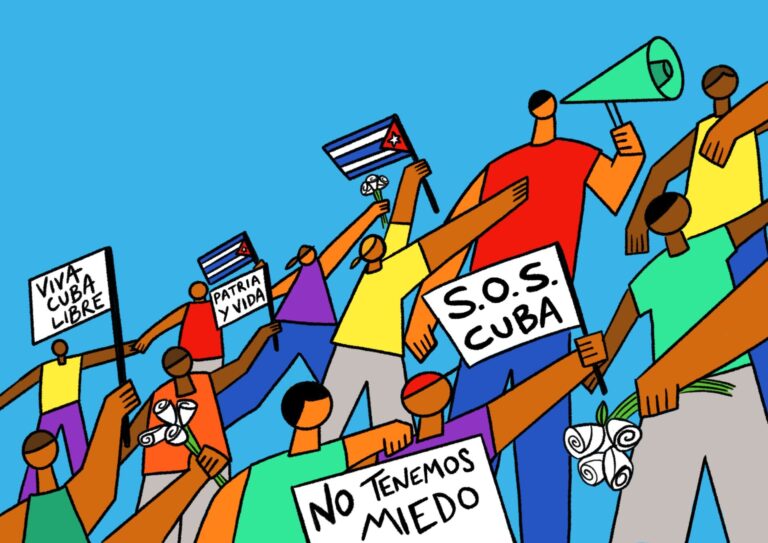
2021 was characterised by peaceful public protest and widespread civic action and unrest unprecedented since 1959. In January, the release of the song ‘Patria y Vida’ (Homeland and Life), by a group of Cuban hip hop artists immediately went viral on social media, becoming a protest anthem for many Cubans, and reflecting a widespread desire for social and political change.
Months later, on 11 July, spontaneous protests spread across the island after livestreams and videos of a peaceful protest march in the town of San Antonio de los Baños were shared widely on social media. Within hours, thousands of citizens were marching in different towns and cities across the country, chanting “Patria y Vida”, “Freedom” and “We are not afraid”. The protests took place days after Hurricane Elsa passed over central Cuba and followed months of growing social tensions with major food shortages, rising prices of basic goods due to high inflation and a spike in COVID-19 cases and which put the health system at risk of collapse. The government responded with violent repression and arbitrary detentions on a massive scale.
On 15 November, the government crushed attempts to organize another wave of peaceful protests. State security agents interrogated and threatened civil society activists and religious leaders in the preceding weeks and put many under surveillance or house arrest. On 15 November, government backed mobs were deployed to surround the homes of activists and some religious leaders while armed police and members of the military patrolled the streets.
It is against this backdrop that CSW documented 272 cases involving 498 violations of freedom of religion or belief (FoRB) in 2021, up from 203 cases in 2020 and 260 in 2019. Those involved reported that a law was mentioned or applied in only 142 of the cases, most commonly the Criminal Procedure Law (Law No. 5 of 13 August 1977), in 134 of those. The most frequently reported FoRB violation, at 115, was being prevented from attending religious services; this mostly affected civil society activists, the Ladies in White in particular. Violations involving harassment or threats were close behind at 107 and 101, respectively. There were 79 violations involving arbitrary detention linked in some way to FoRB. Most, but not all, of these involved short term detention ranging from a number of hours to a few days, usually in order to prevent the targeted person from participating in religious services.
More generally, the year saw an increase in repression against independent civil society, particularly those who had been critical of the government’s record on human rights, starting early in the year with targeted crackdowns on members of the San Isidro Movement and Cuban artists who had participated in Patria y Vida, and escalating after the 11 July protests. In line with this, CSW documented an increase in repressive acts targeting religious leaders and individuals, especially those who had been critical of the government on its FoRB and human rights record in the past. The most common violations included harassment, arbitrary detention, and threats. It is clear that the Cuban government continues to view religious groups, which comprise the largest sector of independent civil society, with suspicion and fear, especially because of their potential to mobilise large groups of people.
Despite these negative developments, CSW noted that many religious leaders – from registered and unregistered groups alike – spoke out publicly against the wave of repression and in support of the right to peaceful freedom of expression following the 11 July protests. Religious groups issued public statements condemning the government’s use of violence against peaceful protestors and calling on the authorities to listen to the demands of the protestors. This level of outspokenness, especially in a context of increased government hostility and violent repression, is unprecedented and should be considered a positive development in the potential for positive transition and reform in Cuba.
Download a copy of the report using the buttons below:

 English (UK)
 Español de México
 简体中文