In 2020, CSW published a new report on freedom of religion or belief (FoRB) in China, entitled ‘Repressed, Removed, Re-Educated: The stranglehold on religious life in China’. The report outlined the rapid and significant decline in the level of FoRB in China, and explained that ‘almost daily new details emerge about the use of technology in surveillance and profiling of Uyghurs in XUAR [Xinjiang Uyghur Autonomous Region], alongside news of another church closure, another anti-xie-jiao campaign, and another flat denial by the government that any of this violates the right to FoRB.’
The violations described in CSW’s 2020 report have continued and, in many instances, have significantly increased. Therefore, rather than replacing the 2020 report, this new report focuses on violations against religion or belief communities that are under-reported or currently developing. It is based on in-depth research by five independent experts, which sheds light on less well-known cases and emerging FoRB developments.
Two years after the 2020 report, the authorities’ crackdown on FoRB has continued increasing in both breadth and severity. In a series of new regulations outlined below, further restrictions on space for registered religious groups have resulted in the complete shutting down of any space for independent religion or belief communities:
| February 2018 | Measures for the Approval and Management of Temporary Religious Activity Sites were published. |
|---|---|
| February 2018 | Newly amended Regulations on Religious Affairs came into force. |
| March 2018 | The implementation of the Five-Year Plan for Promoting the Sinicization of Christianity (2018-2022) was launched. |
| April 2018 | The State Council published a white paper on ‘China’s Policies and Practices on Safeguarding Freedom of Religion and Belief’. |
| June 2018 | The CCP Central Committee and the State Council issued ‘Opinions on Strengthening and Improving the Work of Islam in the New Situation’. |
| January 2019 | The ‘Five-Year Work Plan for Adhering to the Direction of Chinese Islam in China (2018-2022)’ was announced. |
| 2019 | The United Front Work Department and Ministry of Public Security issued the ‘Special Action Plan for Investigating and Handling Christian Infiltration from Abroad in accordance with the Law’. |
| September 2020 | Measures for the Administration of Religious Communities came into force. |
| November 2020 | The Implementation Rules for the Regulations on the Administration of Religious Activities of Foreigners were published. |
| December 2020 | Regulations on the Administration of Islamic Hajj Affairs came into force. |
| May 2021 | Measures for the Administration of Religious Clergy came into force. |
| September 2021 | Measures for the Administration of Religious Institutions came into force. |
| March 2022 | Measures for the Administration of Internet Religious Information Services came into force. |
| June 2022 | Financial Management Measures for Places of Religious Activities came into force. |
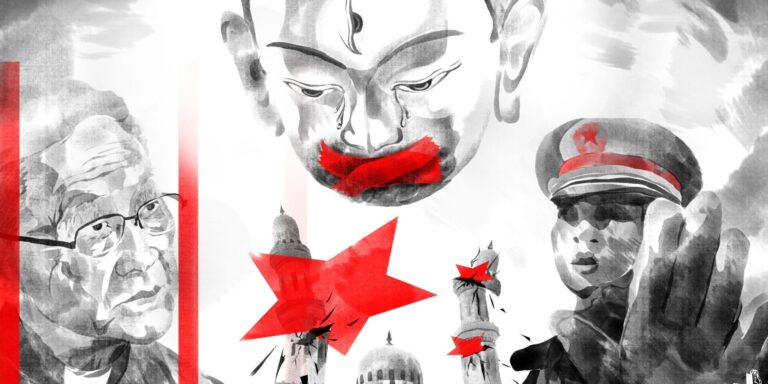
In reality, the restrictions on religion or belief communities have even surpassed the guiding measures from these regulations. Over the past two years we have witnessed more and longer sentences against Christian leaders; the demolition or ‘rectification’ of more religious buildings including churches and mosques; mass arrests of Tibetan Buddhists and the demolition of Tibetan Buddhist statues; and the arbitrary detention and disappearance of countless Falun Gong practitioners, members of the Church of Almighty God and other banned groups, as well as Uyghurs, Kazakhs and other ethnic groups in the Uyghur region, and lawyers and activists who defend the right to FoRB.
‘For Muslims, the dome of their mosque is in keeping with their aesthetics, and through this style of architecture they express their Muslim identity. Destroying the dome is in effect destroying an identity.’
An Ran, Hui poet (detained in January 2020)
From 2020 up to the time of writing this report, the COVID-19 pandemic has radically impacted the lives of people around the world, and China is no exception. However, research from May and June 2020 highlighted by CSW found that even during the most severe period of the pandemic, the demolition of crosses and the banning of churches in various places never stopped. At the same time, members of religion or belief communities who have attempted to find and report information about the pandemic in China have been put in jail:
Falun Gong businessman Fang Bin was taken away by police in February 2020 and his whereabouts remain unknown; Christian citizen journalist Zhang Zhan was arrested in May 2020 and later sentenced to four years’ imprisonment for ‘picking quarrels and provoking trouble’; while in January 2022 artist Xu Na was sentenced to eight years in prison for reporting on the COVID-19 pandemic and practising Falun Gong.
‘In their [police officers’] eyes, Falun Gong practitioners are not human beings…They aren’t allowed any opportunity to defend themselves….They don’t have the rights that even murder suspects have. It’s totally unimaginable.’
Human rights lawyer Jiang Tianyong
The scale and severity of these violations has not gone unnoticed outside China. United Nations experts, the European Union, and democratic governments, parliamentarians and civil society organisations around the world have repeatedly called on the Chinese government to end violations against human rights defenders, citizen journalists, religion or belief communities and others. In particular, greater attention has been paid to the grave human rights abuses in Xinjiang Uyghur Autonomous Region (XUAR), with parliaments, the US government and one people’s tribunal accusing the authorities of genocide or crimes against humanity. 2021 and 2022 also saw further attention to forced labour and in particular action to end forced labour in the Uyghur Region, including the US’s Uyghur Forced Labor Prevention Act (UFLPA), which was signed into law by President Biden in December 2021.
Governments around the world have also introduced sanctions on officials believed to be responsible for human rights violations in XUAR. These actions have been met with fierce criticism from the Chinese government, and counter-actions such as sanctions against academics and parliamentarians including five members of the European Parliament.
‘In 2018, you said our meeting venues were illegal and no one would care if people just met in their homes. Then you said our organisation was illegal. Then you said meeting in homes was also illegal. Now you blatantly insult us and say we are xie jiao [religious movements banned as ‘heterodox teachings’].’
An unregistered house church member, 2021
Despite the efforts made to hold the Chinese authorities to account, the overall FoRB situation in China has continued to decline, as will be demonstrated below.
The first research paper summarised in this report, Article 300 of the Criminal Law and Religions and Beliefs in China: from a Perspective Based on Legal Texts, is based on a study of the implementation of the ‘anti-xie jiao’ Article 300 of the Criminal Law. The author uses case information from official sources to track the application of this Article. The author finds that the Chinese Communist Party has cracked down on various faith groups labelled as xie jiao, in some cases because of their criticism of the Party. The report also examines the way police departments have established databases to control and discriminate against religious people, while the authorities crack down on unregistered house churches using ‘pocket crime’ offences such as ‘disrupting public order’ and ‘provoking trouble’.
In the second research paper, The Chinese Communist Party’s suppression of Islam in China in recent years, the author focuses on the suppression of Islam outside XUAR: across the country, thousands of mosques have had their domes and minarets removed or been completely demolished, sometimes at night to prevent protests by local Muslims; those who have tried to prevent the demolitions have been detained and in at least one case sent to a psychiatric hospital. Schools have been forcibly closed, imams have been arrested, and, in common with other religions, Muslim social media groups, websites and blogs have been shut down.
The third summary is focused on a research paper The Church in the Mountains: rural churches in Yunnan Province which raises concerns about the situation of rural churches in Yunnan Province, where Christians, who make up 97% of the population in some villages, are facing increasing pressure from Religious Affairs Bureaux. Children are prohibited from attending church, with loudspeakers at the door reminding the congregation of this rule if the government-installed surveillance cameras detect minors during Sunday services. The authorities have also frozen churches’ bank accounts so that they are unable to pay their staff, leaving them to survive on potatoes and corn donated by neighbours. In some areas, only a few churches are still maintaining small groups that meet in people’s homes.
Research on The impact of the new Measures for the Administration of Internet Religious Information Services (the fourth research paper) finds that even before the measures came into effect on 1 March 2022, netizens began disbanding WeChat groups on religious topics or changing the names of the groups to avoid religious content. According to the author’s research, it is difficult to find live broadcasts or videos of a religious nature online now, while online religious community sites have been shut down. Alarmingly, several Christians report being warned by employers not to share Bible verses or prayers online.
Finally, in an analysis of the future of religious freedom for Protestants and Catholics in Hong Kong entitled CCP’s Insidious Attack on Religious Freedom in Hong Kong, the author predicts that the authorities will take discreet but serious steps to restrict Christian groups in the city by increasing controls over education and churches, including clergy. The author also suggests how Christian groups may respond to these restrictions, predicting splits between Protestant churches, some of which will turn to small house group meetings in order to survive. The author shares a bleak outlook for Catholic churches in the city, and for freedom of religion or belief overall.
Together, these experts provide a wider and concerning view of the FoRB situation in China. This report aims to provide a space for the opinions of these experts, to amplify their voices as part of our current analysis of common themes from their varied standpoints and experiences. The examples of FoRB violations from these independent perspectives show the wide range and reach of FoRB violations in China. The objective of this report is to inform and inspire policy makers, parliamentarians, researchers, NGOs, media and religious leaders to pay closer attention to FoRB violations in China, and to consider what action they can take to address these abuses.
Download a copy of the report using the buttons below:
 English (UK)
 Español de México
 简体中文