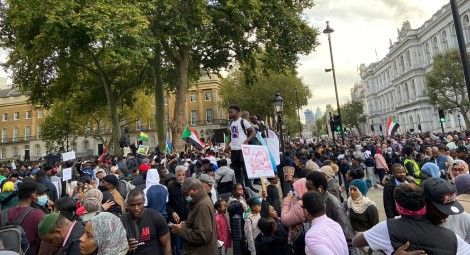

Sudan’s military seized power in a coup on 25 October 2021, bringing the transitional government that was established following the removal of former President al Bashir to an abrupt end and arresting members of the civilian-led administration. The army’s violence towards peaceful protesters and consolidation of political power threatens the fragile legal and political reforms undertaken by the transitional government.
Legal framework
Sudan is party to the International Covenant on Civil and Political Rights (ICCPR). The 2005 Interim National Constitution, enacted prior to the secession of South Sudan, contained provisions for freedom of religion or belief (FoRB)and also made reference to shari’a “and the consensus of the people” as the source of nationally enacted legislation in northern states.
Under the civilian-led transitional government, established following the removal of al Bashir in April 2019, there were some improvements to FoRB, including a constitutional declaration signed in August 2019 which included several provisions protecting the right to freedom of religious belief and worship “in accordance with the requirements of the law and public order.” The constitutional declaration also affirms that the state is “independent, sovereign, democratic, parliamentary, pluralist, decentralized state, where rights and duties are based on citizenship without discrimination due to race, religion, …” making no reference to religion as a foundation of the state.
Laws promulgated under the former constitution remained in effect while the transitional government worked on reforms to Sudan’s legal framework in line with the constitutional declaration. Amendments include the decriminalisation of apostasy in 2020, the removal of flogging as a punishment for blasphemy, and rules allowing non-Muslims to drink, import and sell alcohol.
2019 protests and civilian-led transitional government
Protests erupted across Sudan in December 2018, leading to the removal of Sudan’s president of nearly 30 years, Omar al Bashir, on 11 April 2019, and bringing an end to three decades of oppressive rule characterised by severe and widespread violations of human rights, including of the right to FoRB.
In August 2019, the Transitional Government was appointed, comprising the Sovereign Council of Sudan, chaired by Lt. Gen. Abdel Fattah Abdelrahman Burhan, the civilian-led government, led by Prime Minister Abdalla Hamdok, and a legislative body, to be appointed later. The transition period was expected to run for 39 months, ending in 2022.
Limited improvements in FoRB under transitional government
In addition to the cancellation of Article 126 of the Criminal Code concerning apostasy, 2020 saw some limited positive developments in the situation of FoRB and other human rights in Sudan.
In February 2020 the transitional government issued a statement pledging to hand over those indicted by the International Criminal Court (ICC) for atrocity crimes. In May 2020 the government announced the creation of an independent national commission for religious freedom and a Ministry for Peace and Human Rights.
In December 2020 the governor of Gezira state, Abdalla Ali Ahmed Idriss, authorised the construction of four church buildings on empty land. The last time land was apportioned for church construction was after the signing of the 2005 Comprehensive Peace Agreement, when a South Sudanese minister granted land to the Apostolic Full Gospel Church.
Ongoing FoRB violations and challenges under transitional government
From December 2019 to January 2020 a church building belonging to the Sudanese Church of Christ (SCOC) in Jabarona, Omdurman, was attacked on four separate occasions. In addition to the attacks, church leaders received serious threats from Muslim extremists living in the area, who warned that they would not allow churches to be built in the area even if official permission was granted.
The Ministry of Religious Affairs and Endowments formed a committee to investigate the attacks and threats; however, the church was attacked once again on 14 August 2020, and on 22 August 14 individuals submitted a letter to the Ombada local authority asking it to clear the square where the church is located within three months and threatening to undertake the action themselves if this was not done. The signatories to the letter were put on trial, marking the first prosecutions for damaging a church in the nation’s history. Other churches experienced arson attacks or demolition in 2020 and 2021.
On 31 December 2020 the UN peacekeeping mission in Darfur, known as UNAMID, concluded its mandate, with the withdrawal of all uniformed and civilian personnel from Sudan intended to be completed by 30 June 2021.The withdrawal prompted serious concerns from human rights groups as coming too soon into Sudan’s transitional period, particularly as violence continued to be reported in the region. These fears would be realised when the military seized power in 2021.
2021 military coup
In the aftermath of the 2021 coup, activists have continued to organise peaceful mass demonstrations against the military, which has responded with violence, leading to at least 58 dead and hundreds more injured and jailed. There have also been regular and widespread internet shutdowns and disruption of communications networks, and most bridges into Khartoum have been blocked by containers.
On 19 December 2021 protesters breached the perimeter of the Republican Palace. State security responded with extreme force, including the use of sexual violence against women, girls and men fleeing the area. The UN is currently investigating reports of the rape of 13 women and girls by members of the security forces.
The security situation outside of Khartoum has also deteriorated. In East Darfur hundreds of civilians have been killed and thousands displaced, and many have also been killed and displaced in South Kordofan.
Prime Minister Hamdok signed an agreement with military leader Lieutenant General al Burhan on 21 November 2021, which saw him released from house arrest to continue as prime minister, in order to prevent further bloodshed, and to restore the positive advances undertaken during his premiership. However, it became increasingly clear that the military was the dominant force in the partnership and that civilians did not enjoy independence. He resigned on 2 January 2022.
Lieutenant General al Burhan has made a concerning number of presidential declarations since the 25 October coup in an effort to reverse the limited progress made under the transitional government and undermine the efforts of transitional institutions to hold the former regime to account. He has appointed civil servants known to have links with the al Bashir regime to key positions and on 24 December 2021 granted policing powers – including the powers to search, detain, interrogate, and confiscate property – to the intelligence services, the Rapid Support Forces (RSF) and the army.
Members of these forces were also granted immunity from prosecution, which can only be lifted by the leader of the Sovereign Council, i.e. by al Burhan himself. These sweeping changes render pledges made by the Sovereign Council to investigate attacks on protesters meaningless, as the perpetrators are now protected from prosecution.
Ongoing interference in church affairs
In Sudan, church committees recognised by the Ministry of Guidance and Endowments, which oversees religious affairs, are legally empowered to control a church’s affairs.
During the al Bashir era, the government abused this provision in order to retain significant control over the internal processes of churches and to further restrict the rights of Christians. Interference in church affairs was commonplace and was primarily undertaken by National Intelligence and Security Service (NISS) officers, who pitted Christians against each other. The government would subsequently claim that disputes such as those concerning different committees were an internal church matter that did not involve the state.
Since the military coup, church property belonging to the Sudan Presbyterian Evangelical Church (SPEC) in Kosti, White Nile State, and in Kadugli in South Kordofan State has been taken over by members of a committee convened in violation of the church’s constitution. Furthermore, a SPEC church leader based in Kadugli is facing criminal charges initiated by members of another illegally constituted committee. There have also been concerning decisions by the judiciary that allow for interference in church affairs to continue. In November 2021 a court rejected an agreement that was signed between the Ministry of Guidance and Religious Endowments and the SPEC denomination authorising it to act on behalf of the denomination. In a worrying indication of the return of political judicial decisions, the court gave no explanation for its decision.
Further information on these cases can be found aquí.
Recommendations
To the United Nations and Member States:
- Establish an independent international fact-finding mission to investigate reports of violence against protesters.
- Support the work of the UN Designated Expert on the situation of human rights in the Sudan and ensure the mandate is fully resourced to fulfil its duties.
- Condemn the military coup of 25 October in the strongest terms and use all possible measures to hold those responsible for causing the human rights situation to deteriorate to account, including through the use of targeted sanctions where appropriate.
- Call on military representatives to urgently transfer power to a civilian government and support efforts towards a democratic transition with a fully-civilian-led government, ensuring the process is inclusive and Sudanese-led, with a clear procedure and timeline for establishing a legislative body and independent judiciary, creating accountability mechanisms, and conducting inclusive, fair, and transparent elections.
- Support systemic and comprehensive reforms including security sector reform and economic reforms, emphasising the equal citizenship and rights of women, religious and ethnic minorities, and historically marginalised groups.
- Urge all relevant UN mechanisms, including the Special Procedures and Treaty Bodies, to include the right to FoRB in their monitoring and reporting on Sudan, addressing the vulnerabilities and violations faced by religious and belief communities and those seeking to defend them.
To the European Union and Member States:
- Encourage regional and international bodies to establish an international fact-finding mission to investigate reports of violence against protestors.
- Hold those responsible for human rights violations to accountthrough sanctions where appropriate. This should include clear communication of changes required for the sanctions to be lifted.
- Support a truly democratic transition for Sudan, which includes a diversity of groups from Sudanese civil society.
- As part of any dialogue or negotiations with the military, insist that all civil servants appointed before the coup remain in post. We are particularly concerned by the steps taken by the military to recall ambassadors and undermine institutions by removing civil servants who were appointed during the transitional period, replacing them with others aligned to the previous regime.
To the government of the United States of America:
- Continue to monitor FoRB in Sudan and consider placing the country on the Special Watchlist
- The Ambassador for International Religious Freedom, and the US Commission for International Religious Freedom (USCIRF) should request an invitation to visit Sudan with unhindered access to all parts of the country.
- Deny US travel visas to Sudanese military and government officials directly responsible for FoRB violations.
- Impose targeted sanctions on individuals or entities that are engaged in serious human rights abuses, including of FoRB, during the post-coup period.

 English (UK)
  Español de México
  简体中文
简体中文